Building the Menus: How Do You Set Up Any Match?
Most wrestling game menus are something you click through on the way to the match. For Eternal Wrestling, I wanted the menus to be part of the pitch: the first thing you see should tell you this game is different, and the match builder should let you set up almost anything you can imagine.
None of what you’ll see here is playable yet. These are mockups, but they’re designed to become the game’s real menus, and working through them has already shaped how the game works underneath.
The main menu
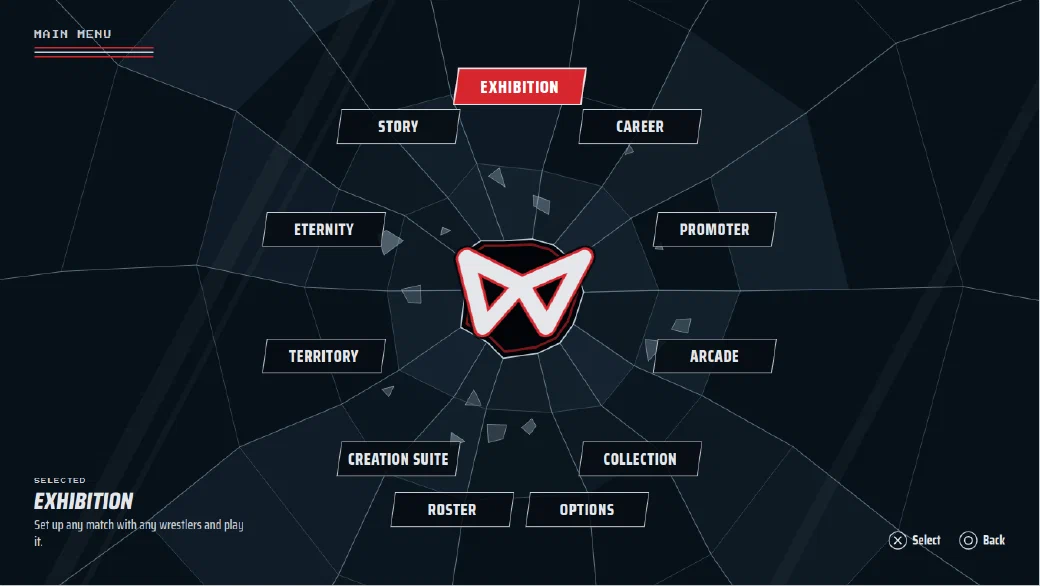
The main menu is a sheet of blue-tinted glass with the Eternal Wrestling logo lodged in the hole it just punched through, shards still flying loose. The modes sit in a ring around it, with Exhibition at the top, the rest paired down each side, and Roster and Options at the bottom.
The shards don’t stop at the main menu. They carry into every sub-menu in new positions, as if the glass is still moving. It’s a small touch, but it makes the menus feel like one continuous moment instead of a stack of separate screens.
Four steps to any match
Exhibition runs through four steps: Start, Layout, Rules, Wrestlers.
Start is where you choose between a preset, a match you’ve saved, or building something new. Presets are the quick way in. Pick one, and it fills in every setting and jumps straight to choosing wrestlers. You can still tweak it, and the builder shows when you’ve changed a preset, so you always know whether you’re playing the standard version.
Layout sets the stage, and this is where things get big. You can have up to 30 sides in any combination: one against seven, four tag teams, three-on-three-on-two. You can use one to four rings, in 4, 6 or 8-sided shapes, raised, at floor level or sunken. And you can stack cages up to three tiers high, each smaller than the one below, with wrestlers climbing a ladder through a hole in the roof to reach the next level.
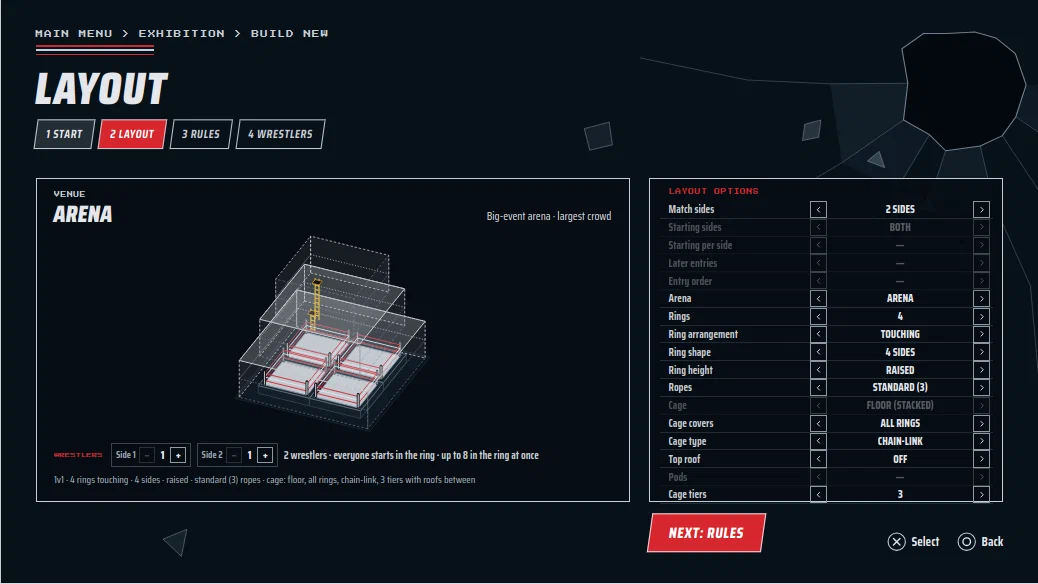
There’s one limit that shaped a lot of this: no more than 8 wrestlers in the ring at once. That’s set by the hardware the game is aiming for, and it could rise on newer consoles. But it doesn’t cap how many wrestlers a match can have in total. Matches can start with some wrestlers in the ring and bring the rest in on a timer, every 30 seconds up to every few minutes, or one at a time after each elimination. That one setting covers battle royals, timed-entry matches, gauntlets, and team cage matches where squads enter one member at a time.
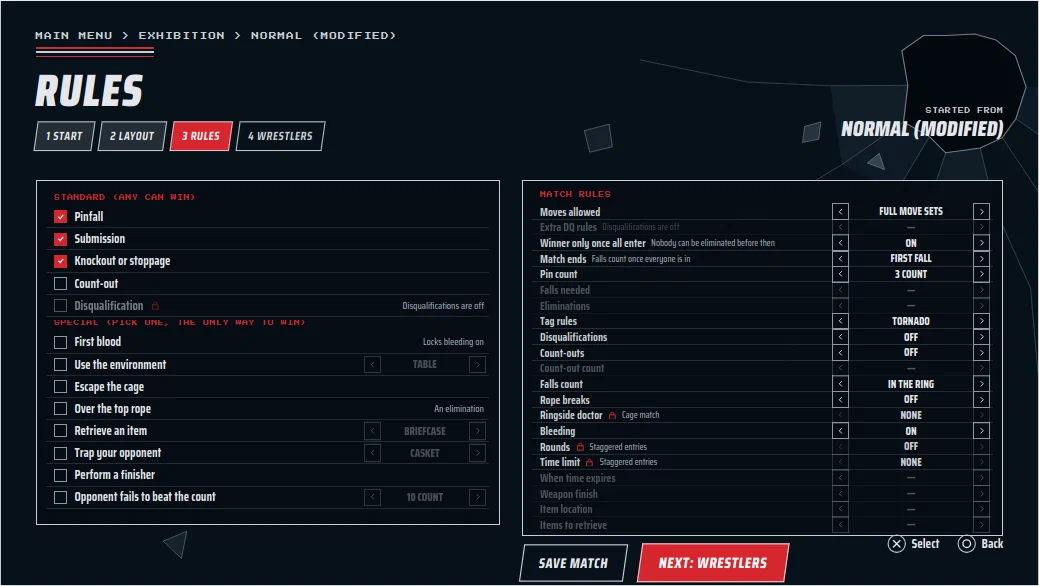
Rules decides how the match is won and how it ends. There are the standard ways to win (pinfall, submission, knockout, count-out, disqualification) and special ones like first blood, putting someone through a table, escaping the cage, grabbing an item hung above the ring, or trapping your opponent in a casket. Then you choose how the match ends: first fall, last side standing, best of 3, 5, 7 or 9 falls, or the most falls before time runs out. There are also rounds, rope breaks, tag rules, and a nod to older eras: you can make closed fists, top-rope moves, or throwing someone over the top rope a disqualification.
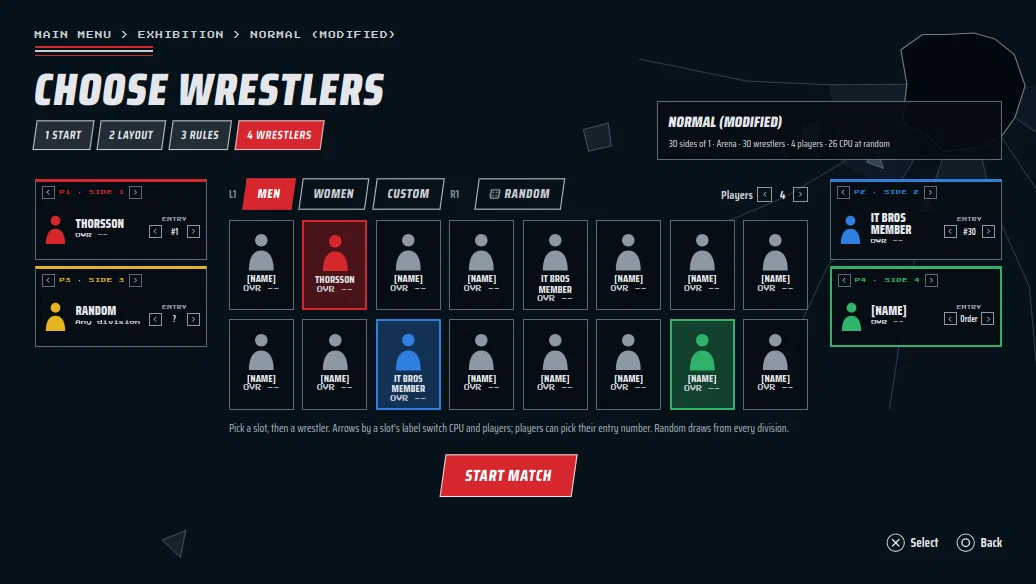
Wrestlers comes last on purpose. Your layout decides how many slots there are, so it makes sense to fill them once you know. Each side gets its own color, up to 8 people can play on one screen, and in timed-entry matches every player can pick their entry number, or leave it to chance.
The hard part: rules that depend on each other
Letting players combine everything sounds great until two settings contradict each other. A cage with a roof on it can’t be escaped. A match where falls count anywhere doesn’t need count-outs. A match decided by the most falls before time runs out can’t have no time limit.
So a big part of designing the menus was mapping which settings force others. A few of the rules I landed on:
- Special win conditions stand alone. Pick first blood or a table win, and it becomes the only way to win. The standard win conditions switch off.
- Impossible options disappear. Add a roof to a cage, and “escape the cage” is no longer an option.
- Settings only lock when they have to. Early on, timed entries forced eliminations on. That turned out to be too strict, because some team cage matches end on a single fall once everyone is in. Now eliminations stay your choice unless the match truly can’t work without them.
That last one is a good example of why I’m working this out now, on paper, instead of after the game is built. Every rule that’s too strict is a match someone can’t make, and every rule that’s too loose is a match that breaks.
What’s next
The menus will keep evolving as the game does. Next up on the engine side is the final build phase: signature moves, finishers and the referee. I’ll write about that here too.
If you want to follow along, sign up below to hear when the Kickstarter launches, or follow the build on social media.
All screens shown are work-in-progress mockups and may change.